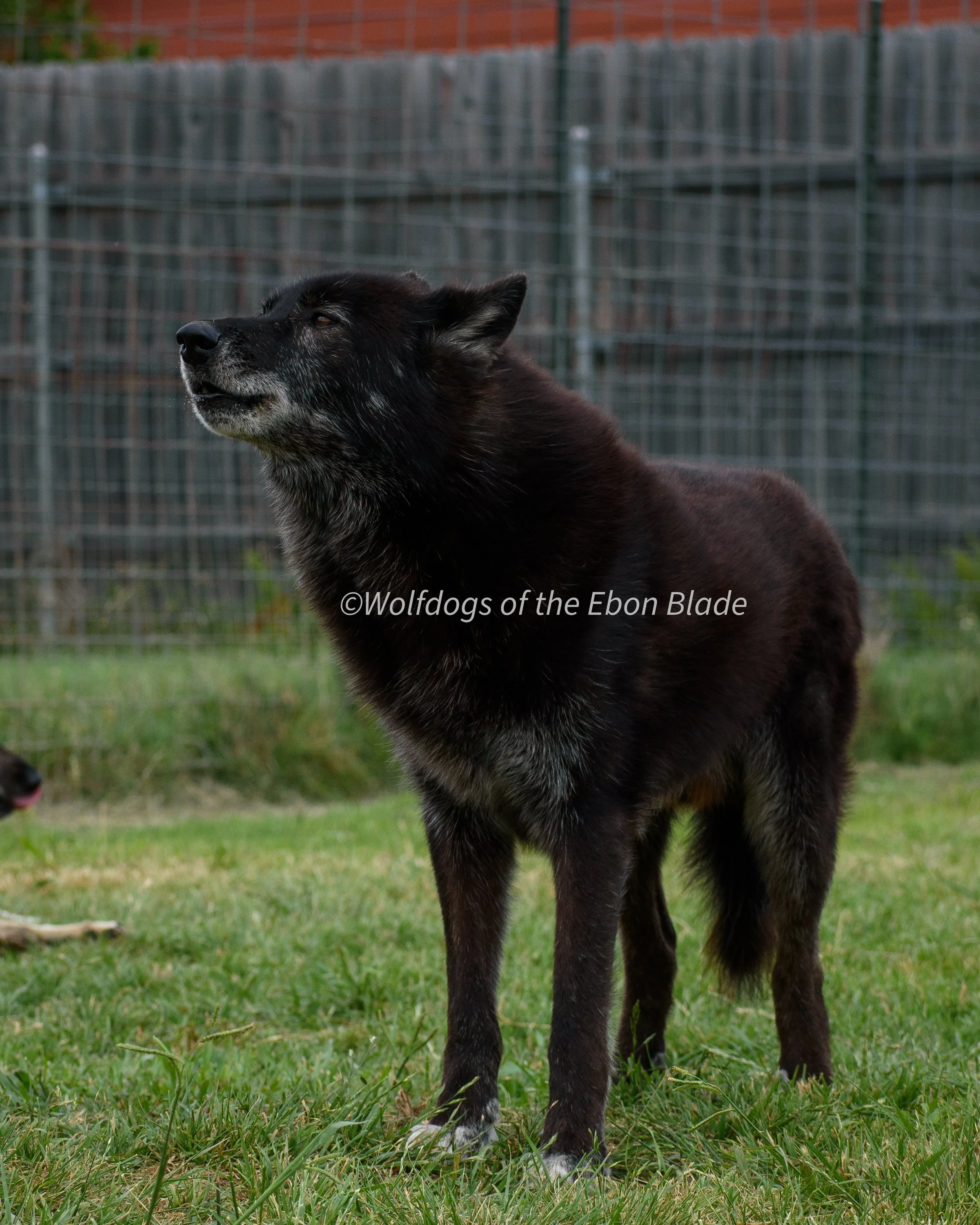
Winecup of the Ebon Blade “Teddy”
x
Nat Ch Shivermaw of the Ebon Blade “Mint”
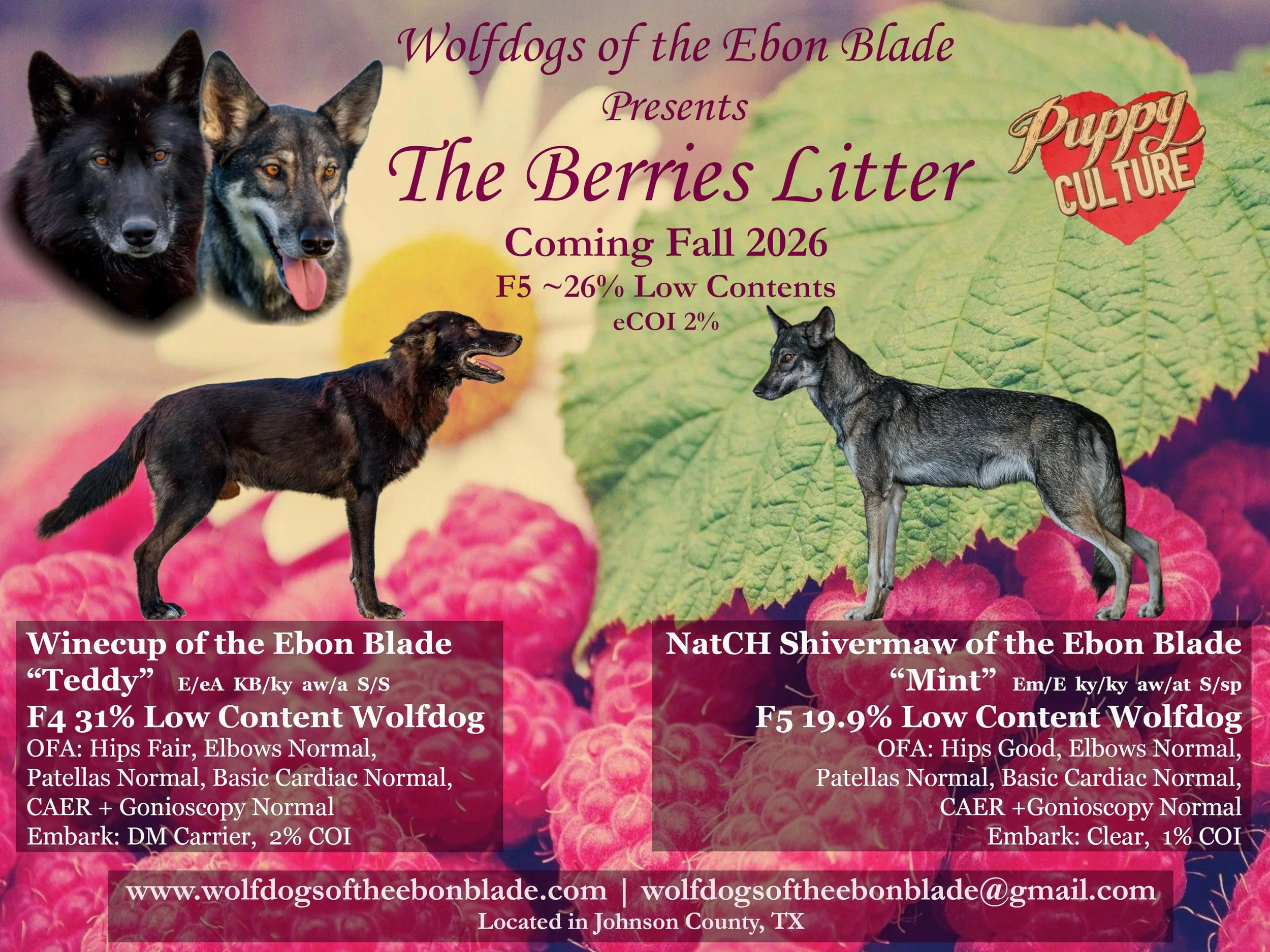
The Berries Litter
Due: July 26, 2026
Puppies from this litter will be Embarked prior to going to their new homes. We expect the litter to average 26% total Gray Wolf, including the wolf content inherited from Saarloos Wolfhound and Czechoslovakian Vlcak heritage. This litter will be whelped and raised inside our home. Puppies will nurse naturally with Mint, but will receive intensive hands-on handling and socialization daily. We use Puppy Culture as the foundation of our puppy raising, socialization, and introductory training process. Puppy Culture includes Early Neurological Stimulation, age-appropriate activities and brain games for each stage of development, and a strong focus on building positive associations with each puppy’s interactions with new people, places, and objects.
Our dams are dewormed before and during pregnancy, and the litter and nursing dam are dewormed every 2 weeks to prevent internal parasites. Our puppies are microchipped and receive age-appropriate vaccinations from our veterinarian, as well as a fecal test, full-body evaluation and Health Certificate prior to each puppy going to their new homes.
Puppies from this litter will be ready to go home at 10 weeks of age. All of our puppies are sent home with a puppy package that includes (but is not limited to): fully-signed ownership contract; vet records and Health Certificate; pedigree; copies of parents’ OFA health test results; a new collar, leash, and harness; brand-new hard plastic travel crate; blanket; toys; treats; cleaning supplies for the trip home; food and water bowls.
Non-breeding puppies from this litter are priced at $2,500.00 USD. Deposits are only accepted after a fully completed application has been submitted and the applicant has passed our interview process and signed our Deposit Contract. Please click the button below to be redirected to our Application Form to begin this process:
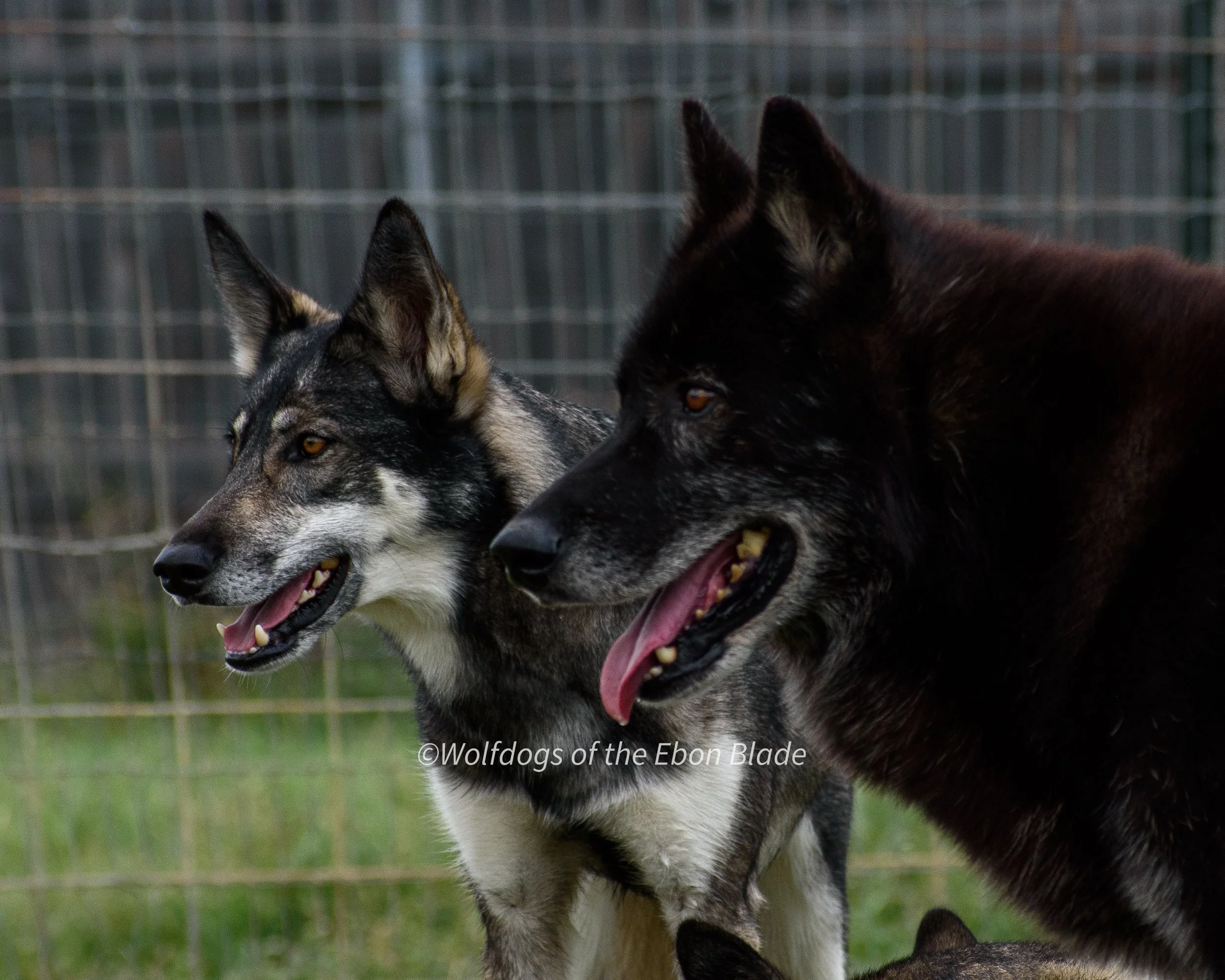
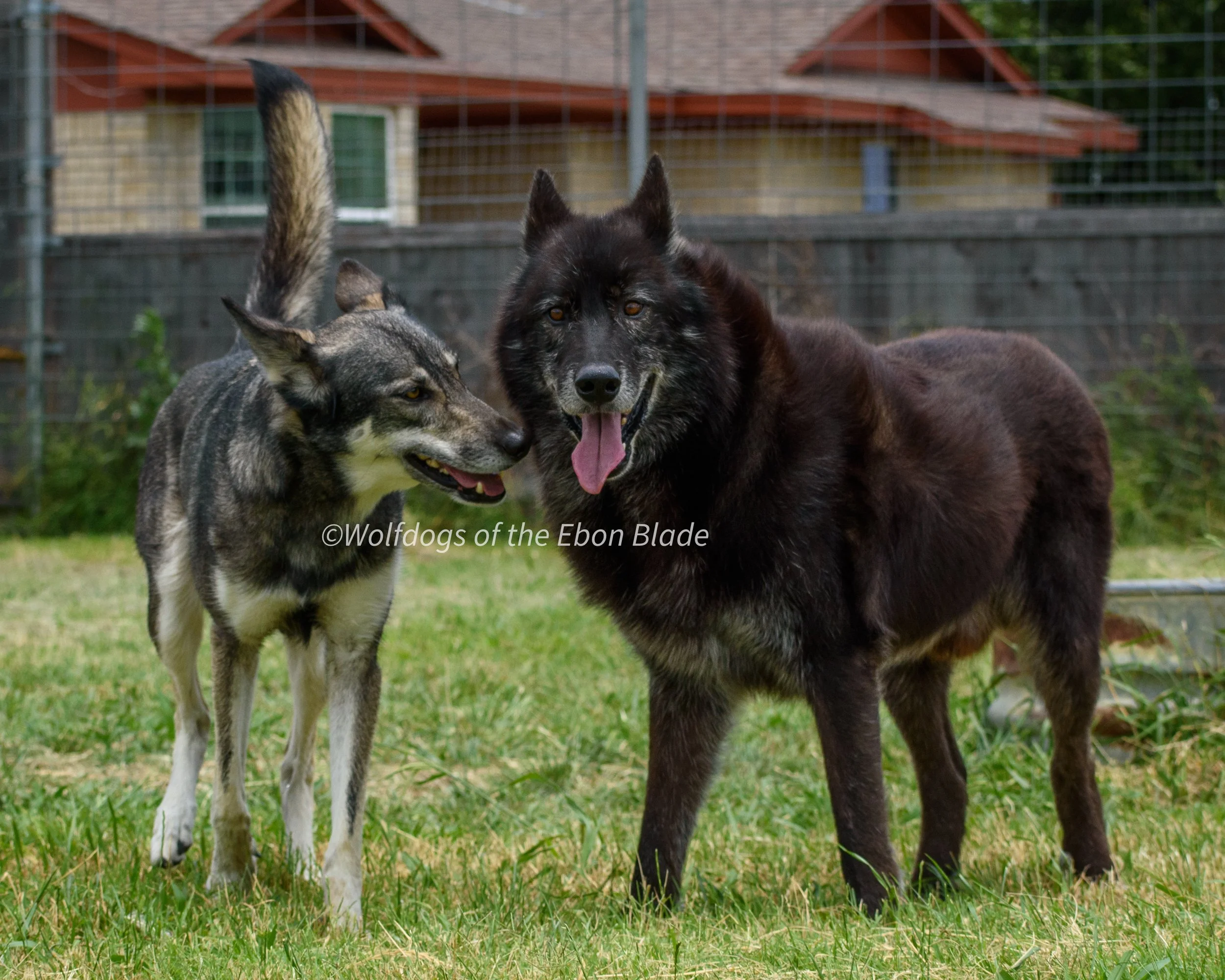
Meet the Parents…
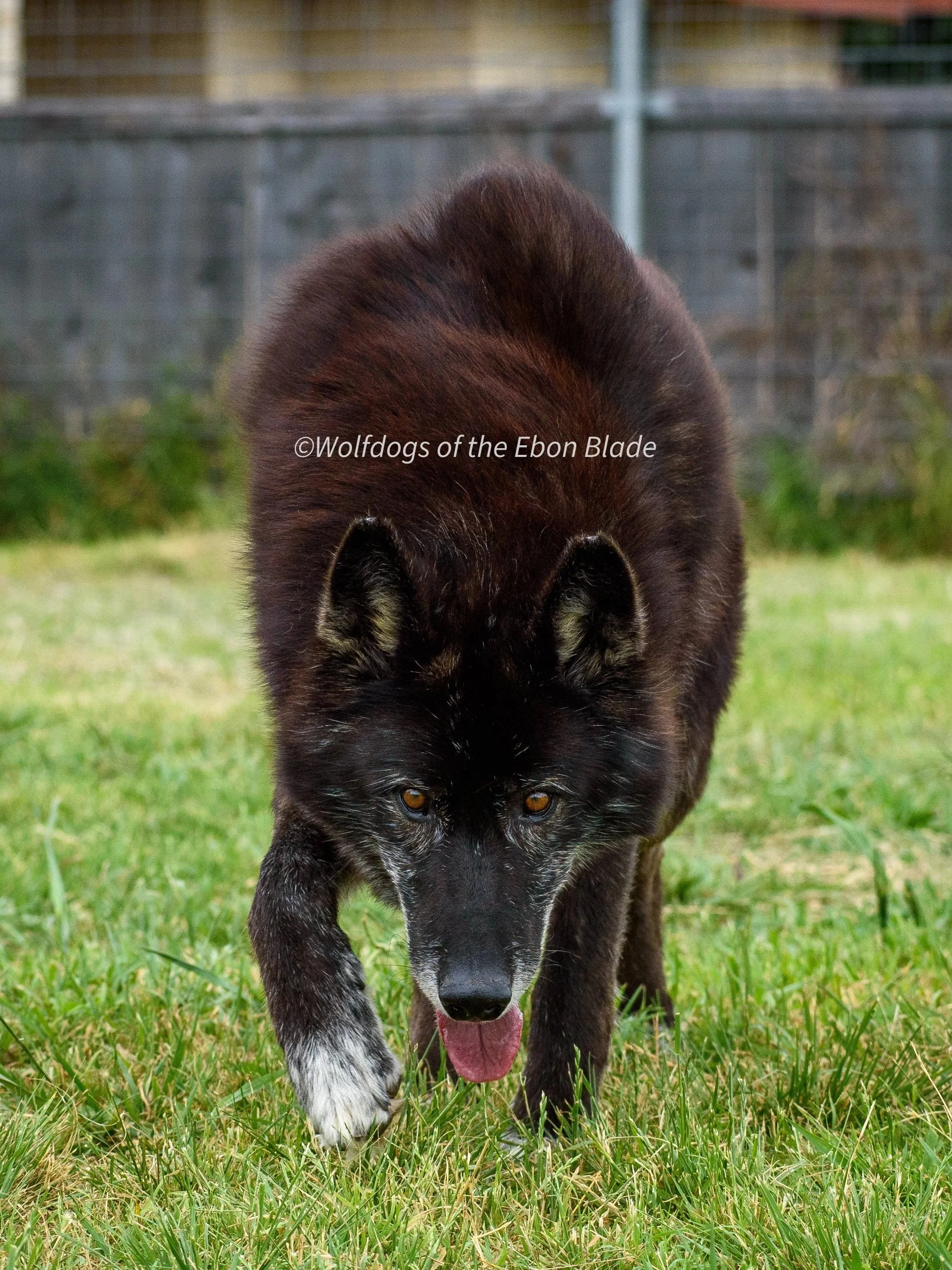
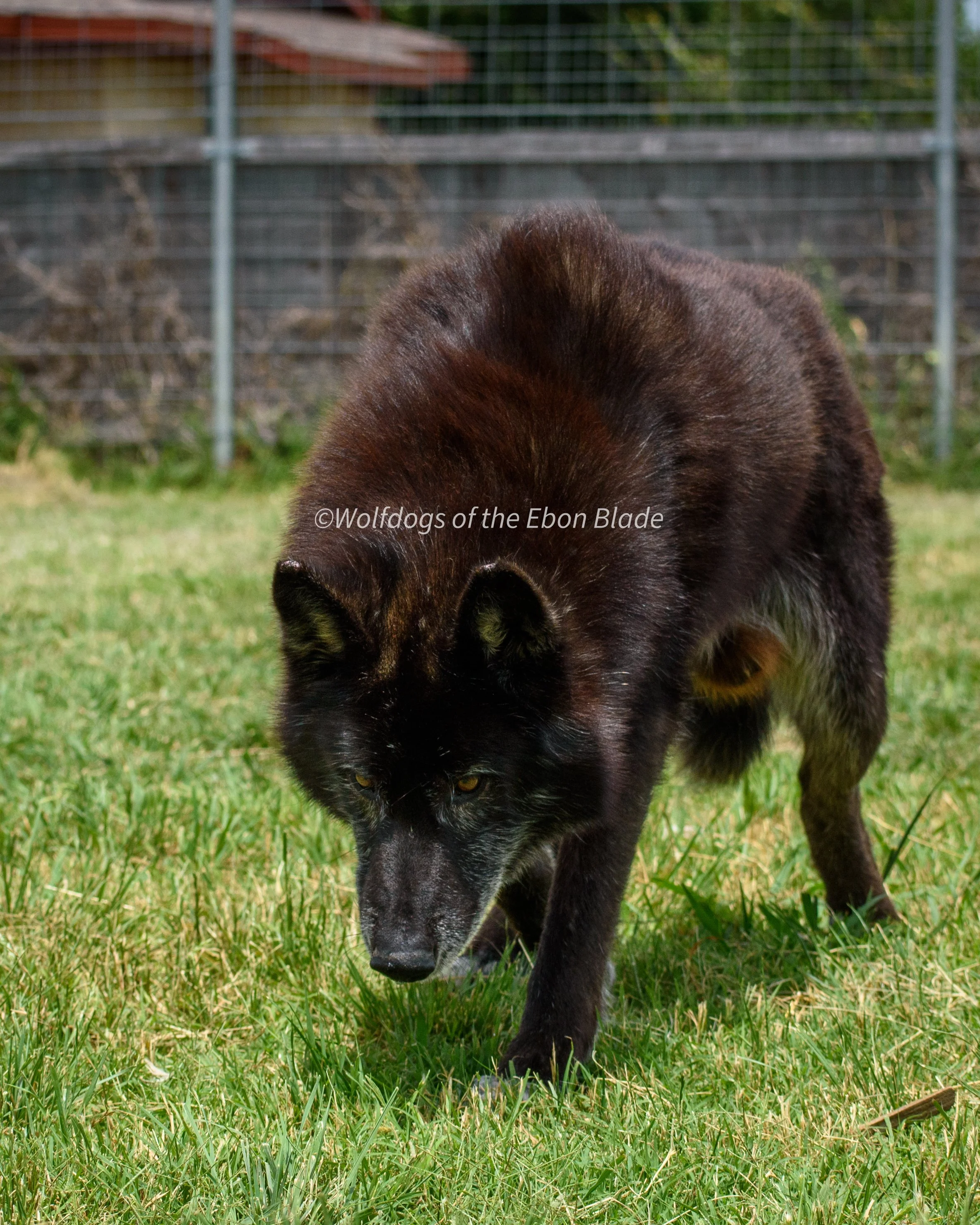
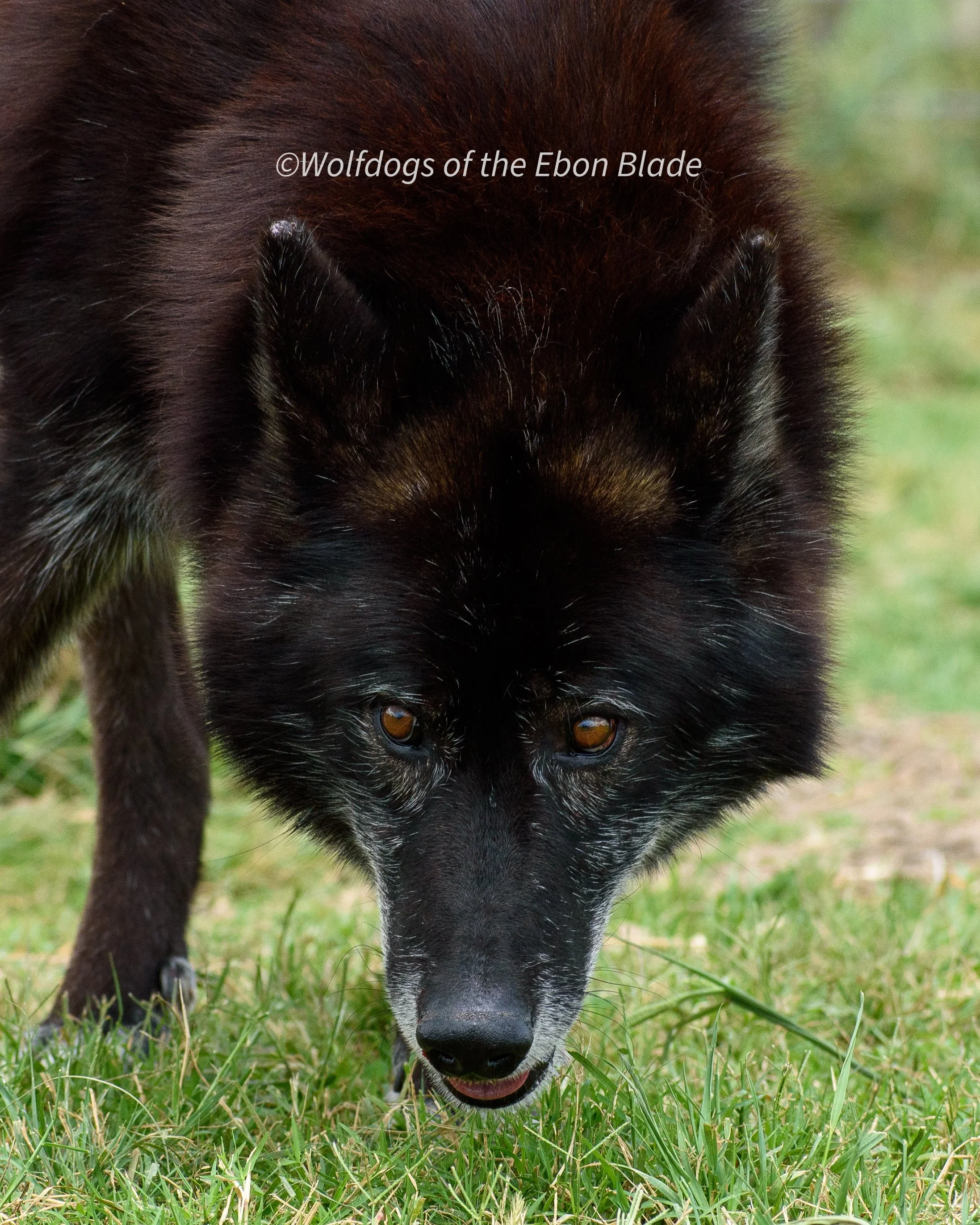
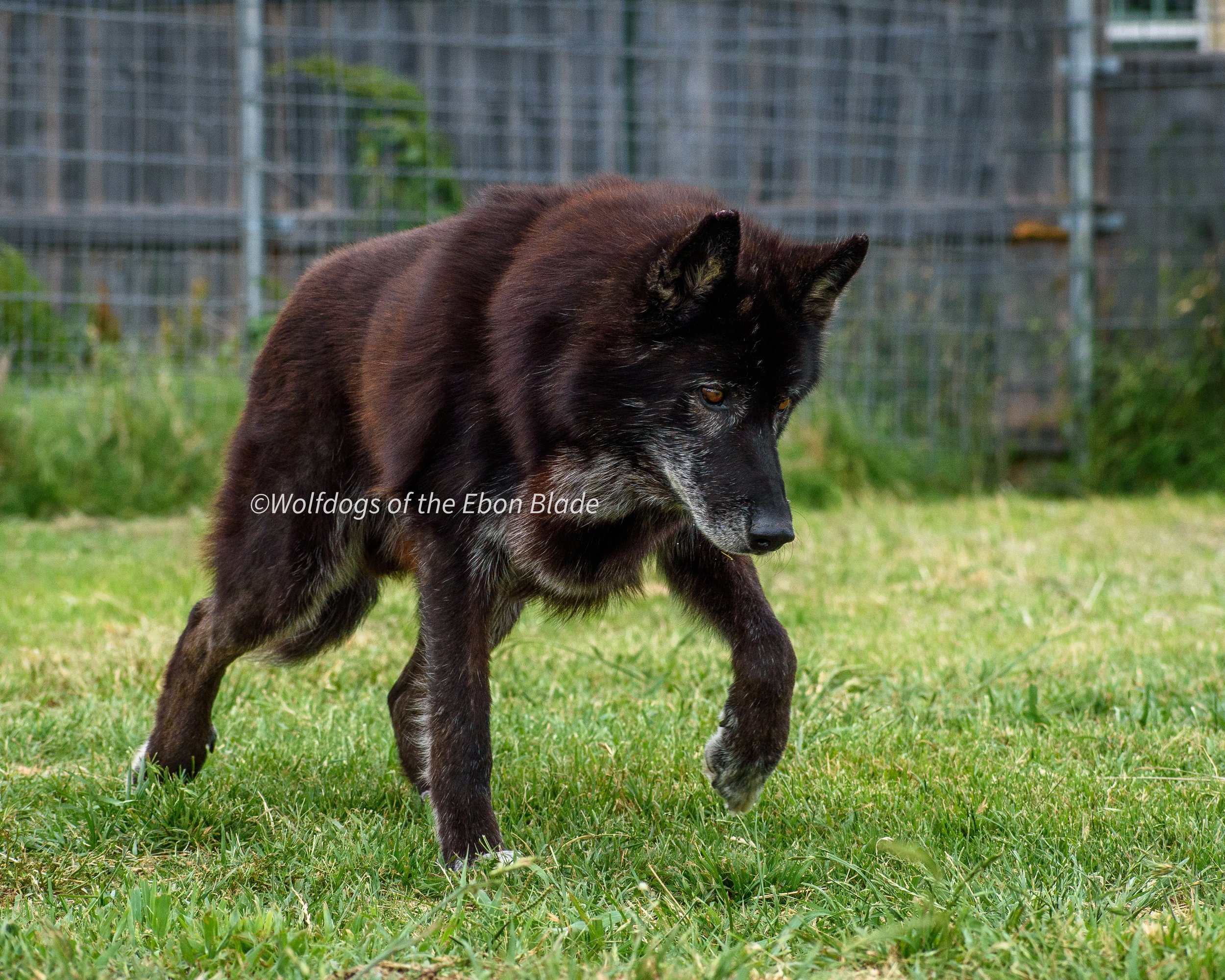
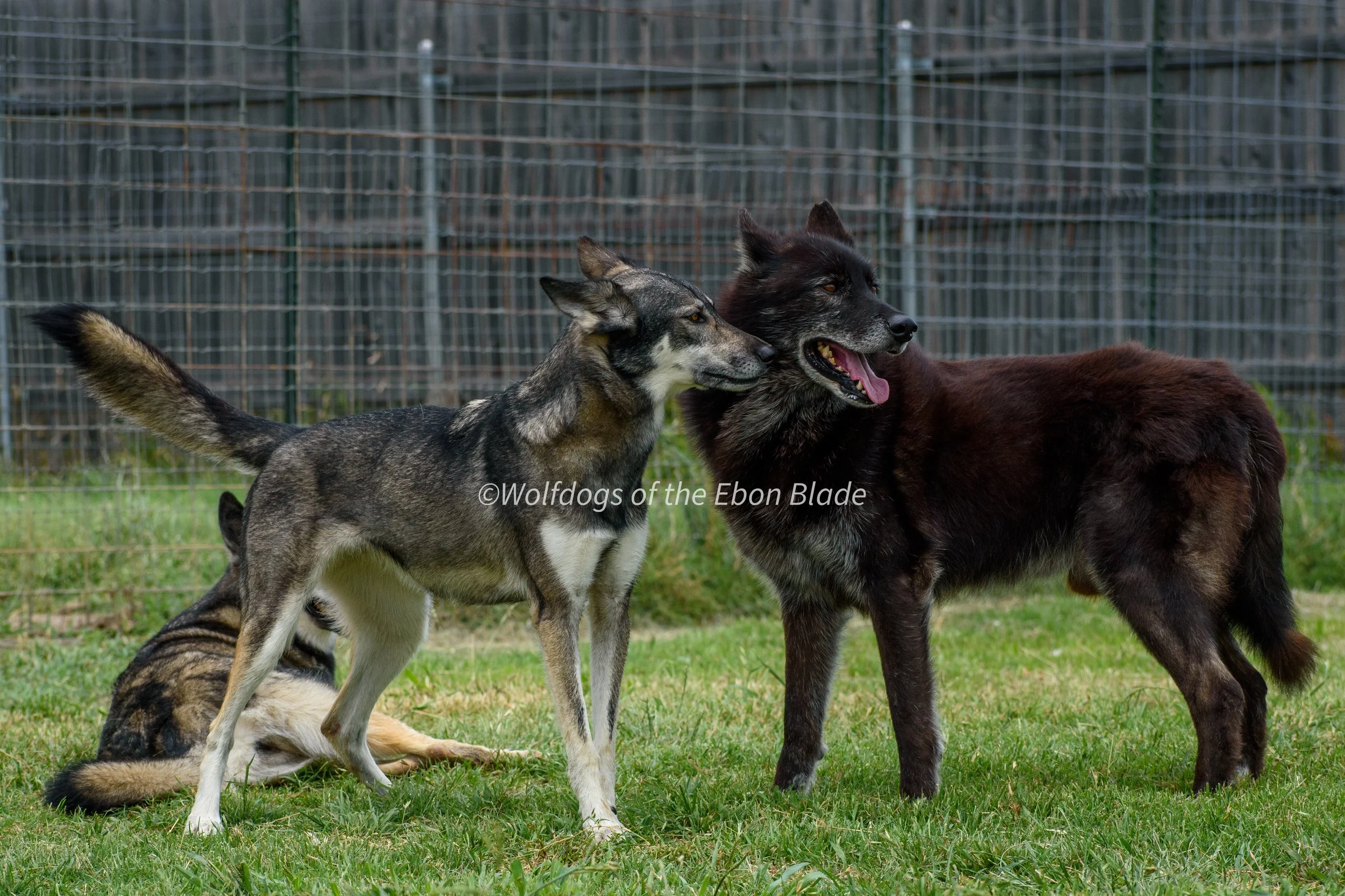
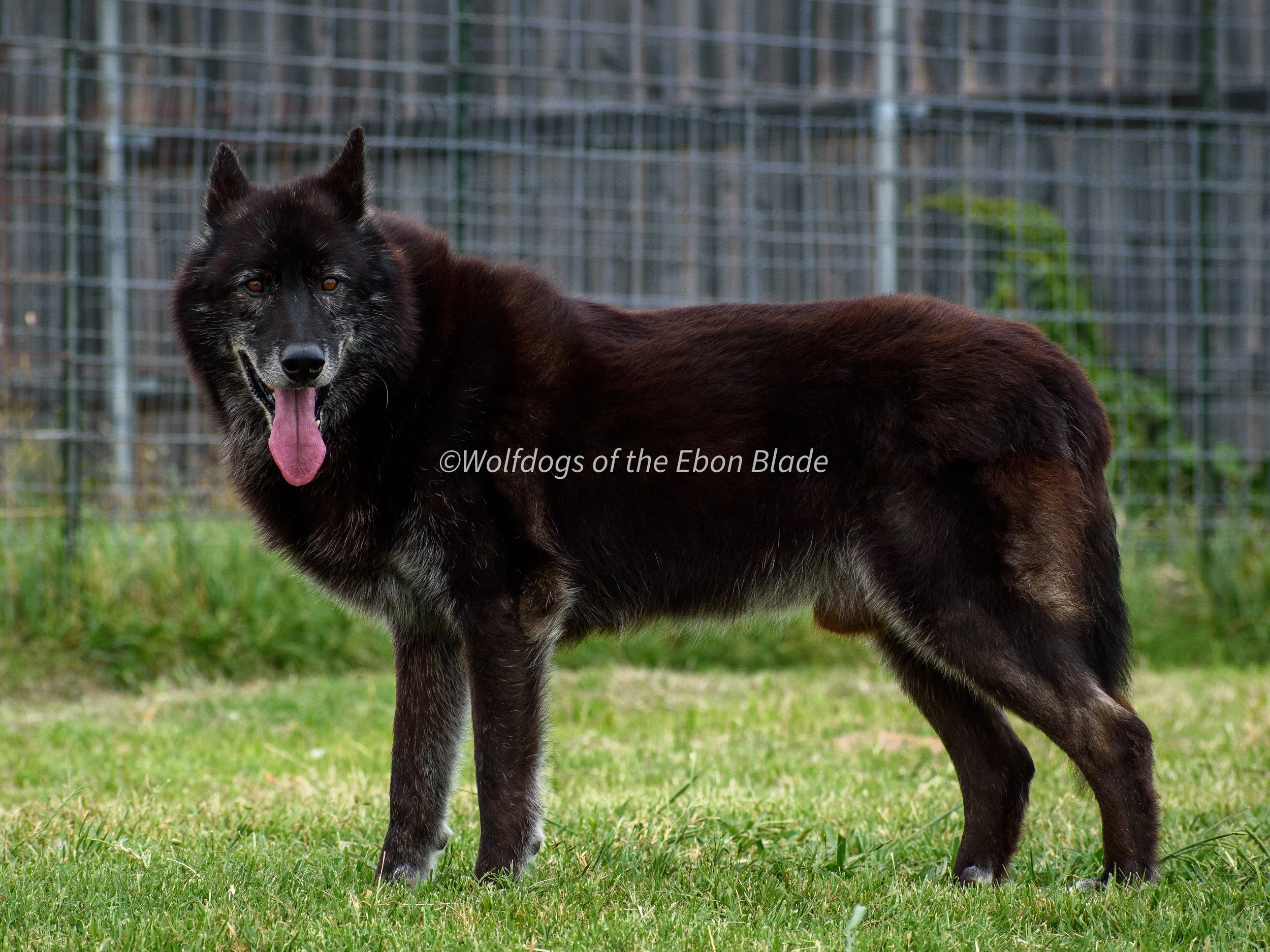
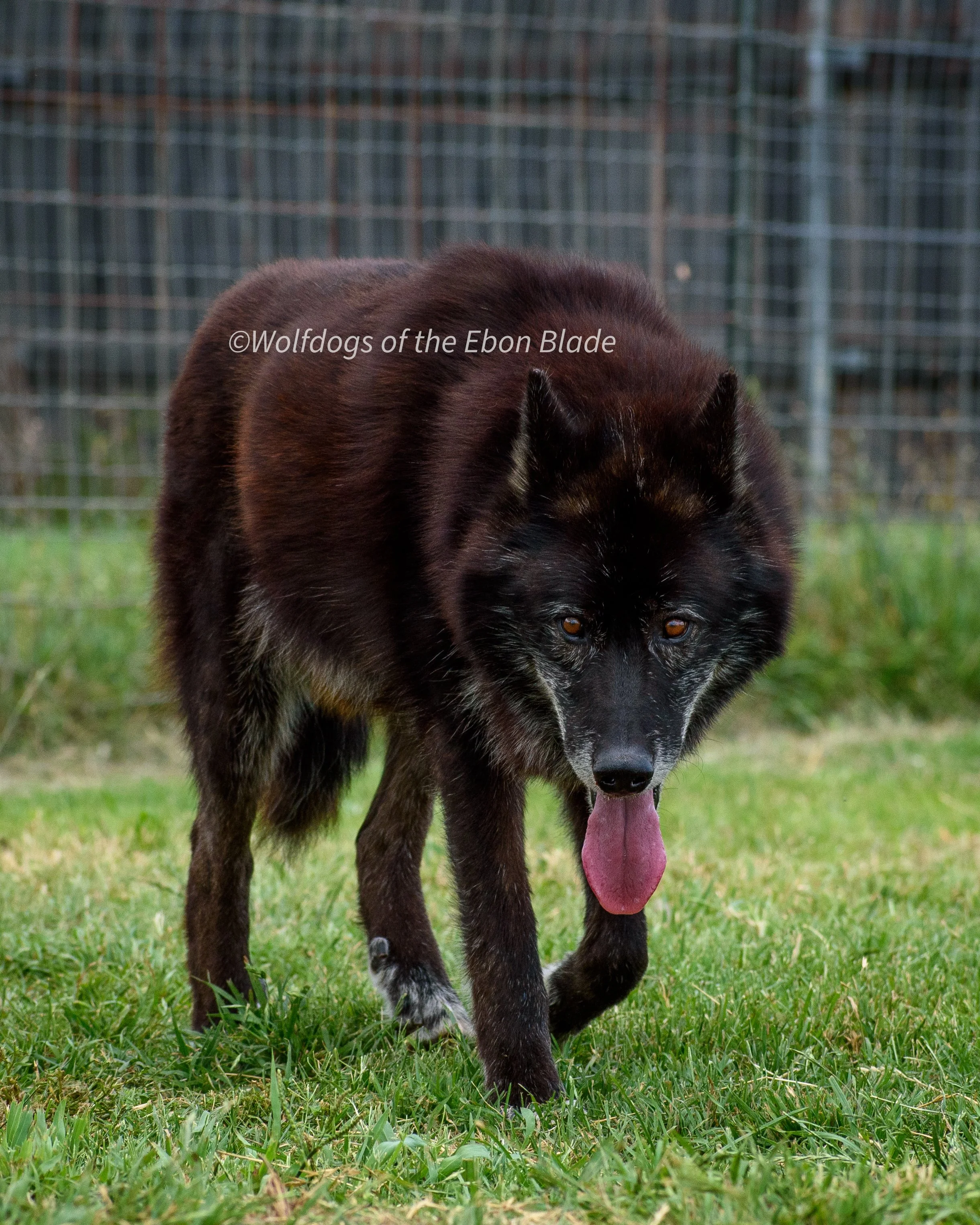
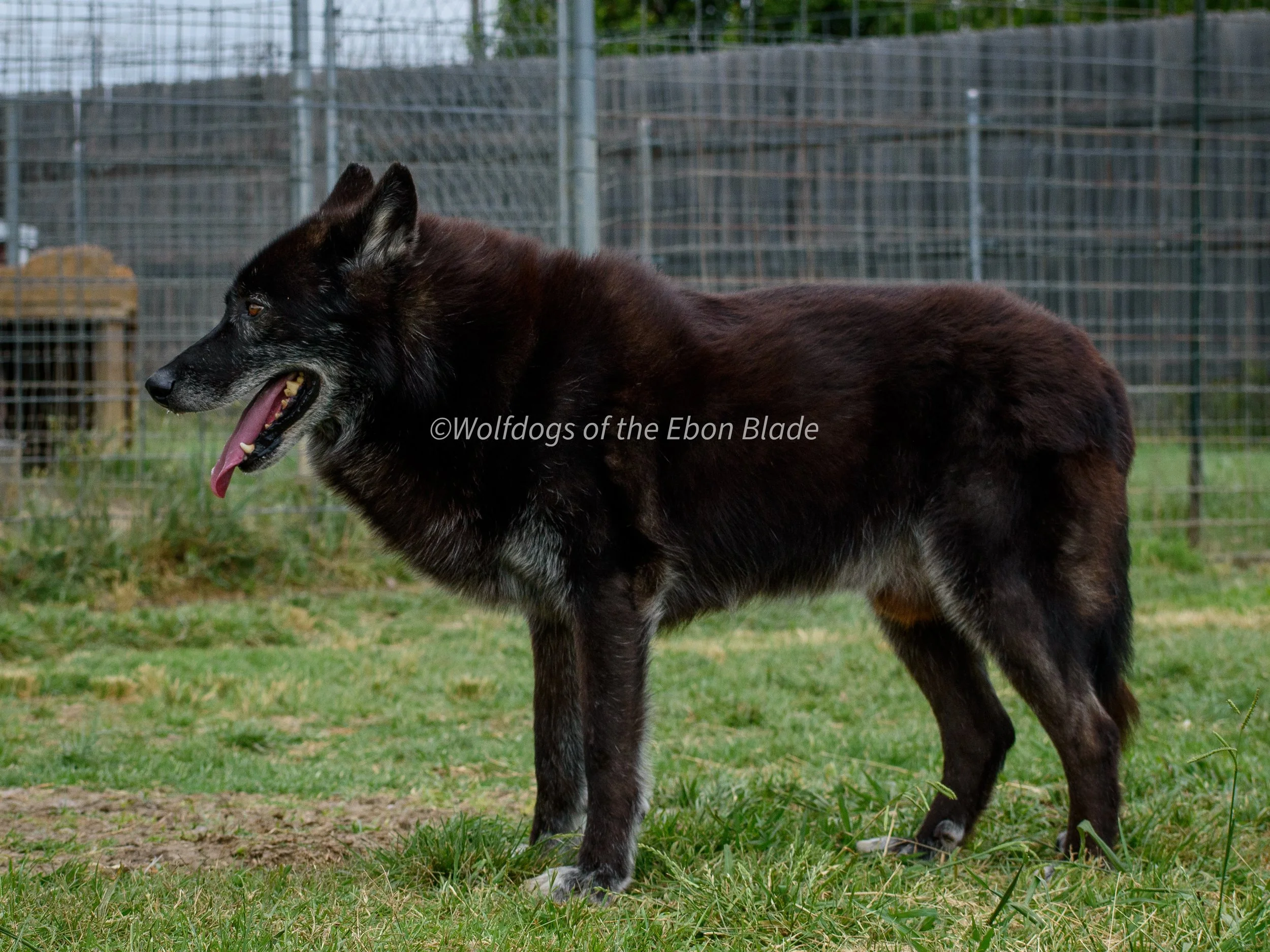
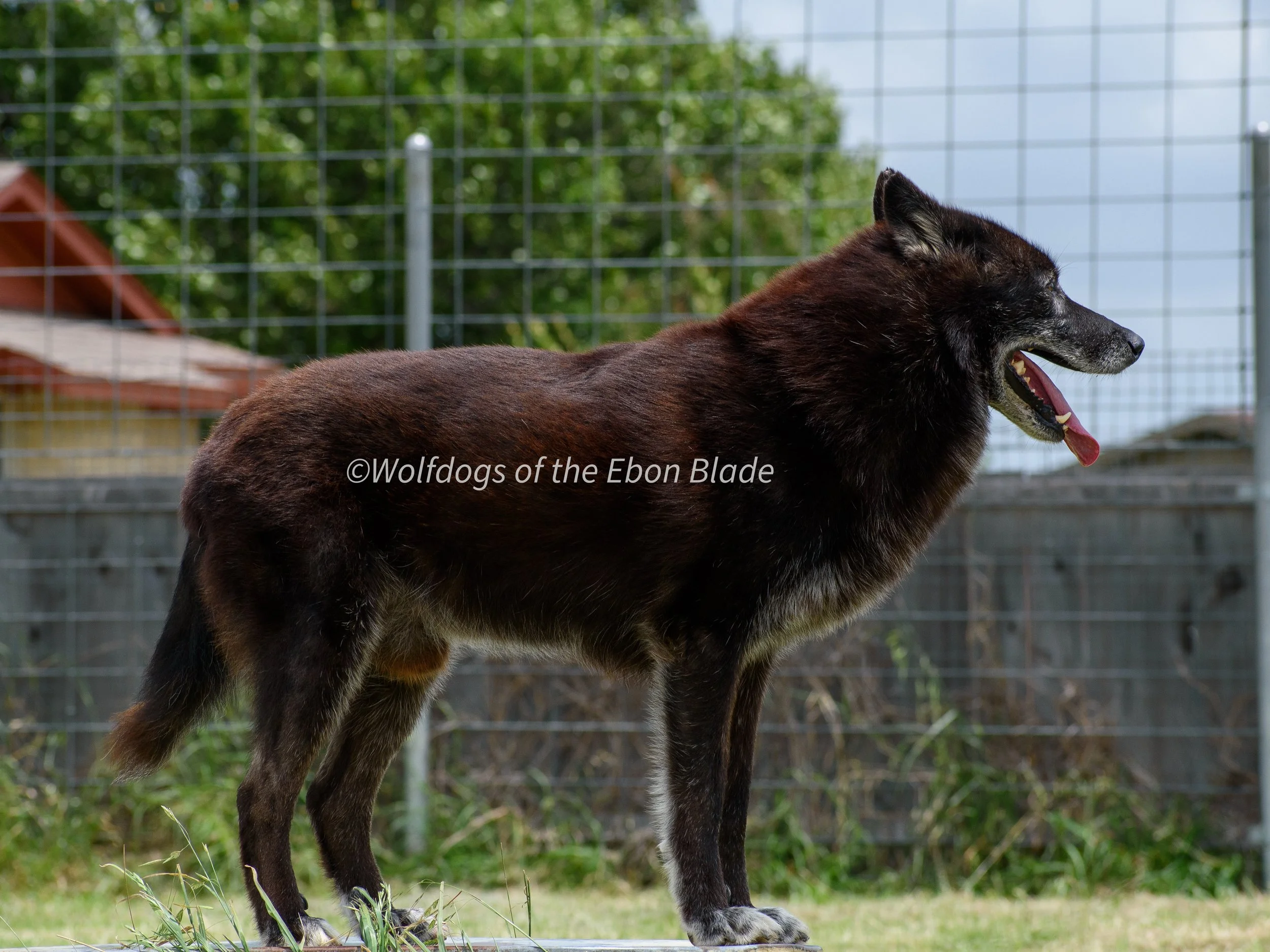
Winecup of the Ebon Blade
“Teddy”
Born: June 27, 2018
F4 31% total Gray Wolf - Low Content Wolfdog
OFA: Hips Fair, Elbows Normal, Patellas Normal, Dentition Full, Basic Cardiac Normal (Jun 2021), CAER + Gonioscopy Normal (Jun 2021)
Embark: DM Carrier
COI: 2%
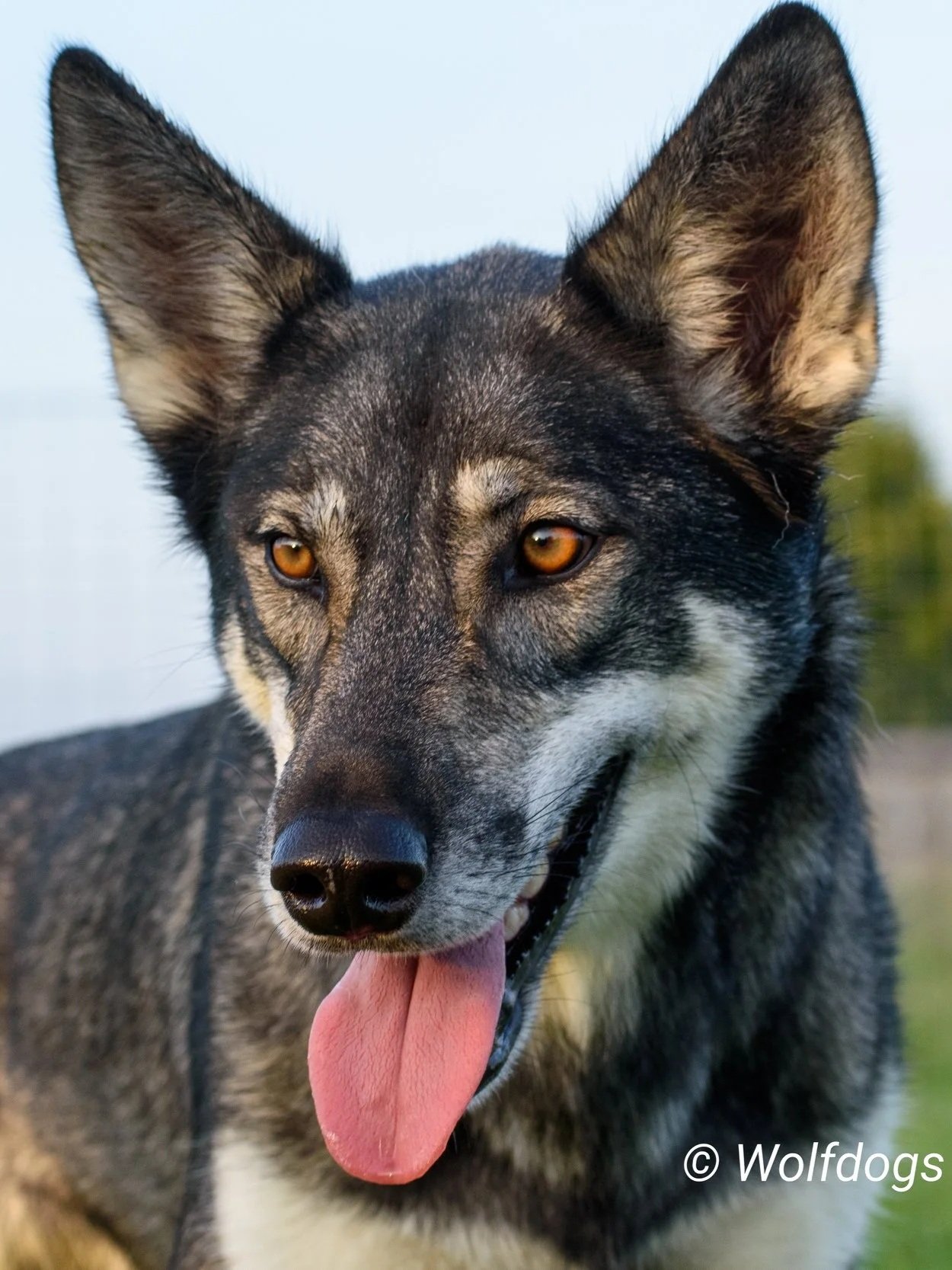
Nat Ch Shivermaw of the Ebon Blade
“Mint”
Born: September 20, 2022
F5 19.9% Gray Wolf - Low Content Wolfdog
OFA: Hips Good, Elbows Normal, Patellas Normal, Basic Cardiac Normal (Nov 2025), CAER + Gonioscopy Normal (Nov 2025)
Embark: Clear
COI: 1%
What we expect from this litter…
Our goal with our low content litters is to produce wolfdogs who are going to thrive as family pets that can live as indoor dogs. Some of our low content litters will be higher in energy than others - Teddy and Mint’s litter is one where we expect moderate energy levels, meaning these puppies will do well with an active lifestyle, but should still have a good “off switch” at home. Both Teddy and Mint are very adaptable to our current activity level and are happy to relax or be active with us as the situation demands.
Teddy and Mint are both very affectionate, silly, and playful dogs who not only enjoy spending time with us, but will seek us out for bonding and affection. We expect their puppies to be similarly loving and dedicated to their families. Crate training, potty training, and general house manners came very easily to both Teddy and Mint, as well as their siblings and parents, so their puppies should similarly make excellent house dogs. Neither Teddy nor Mint are destructive in the house.
Prey drive is something that we may see a range of with this litter. Several of Mint’s littermate siblings quite literally have cat best friends that they will snuggle and play with. Teddy and his siblings have shown signs of prey drive towards chickens and loose neighborhood barn cats, but we do not allow them the opportunity to act on that. Overall, we think that Teddy and Mint’s puppies should have low to moderate prey drive, but that it should be manageable with training. We don’t recommend allowing puppies from this litter unsupervised access to small animals, but do think that they can achieve a respectful coexistence with any household smaller pets with consistent training and supervision.
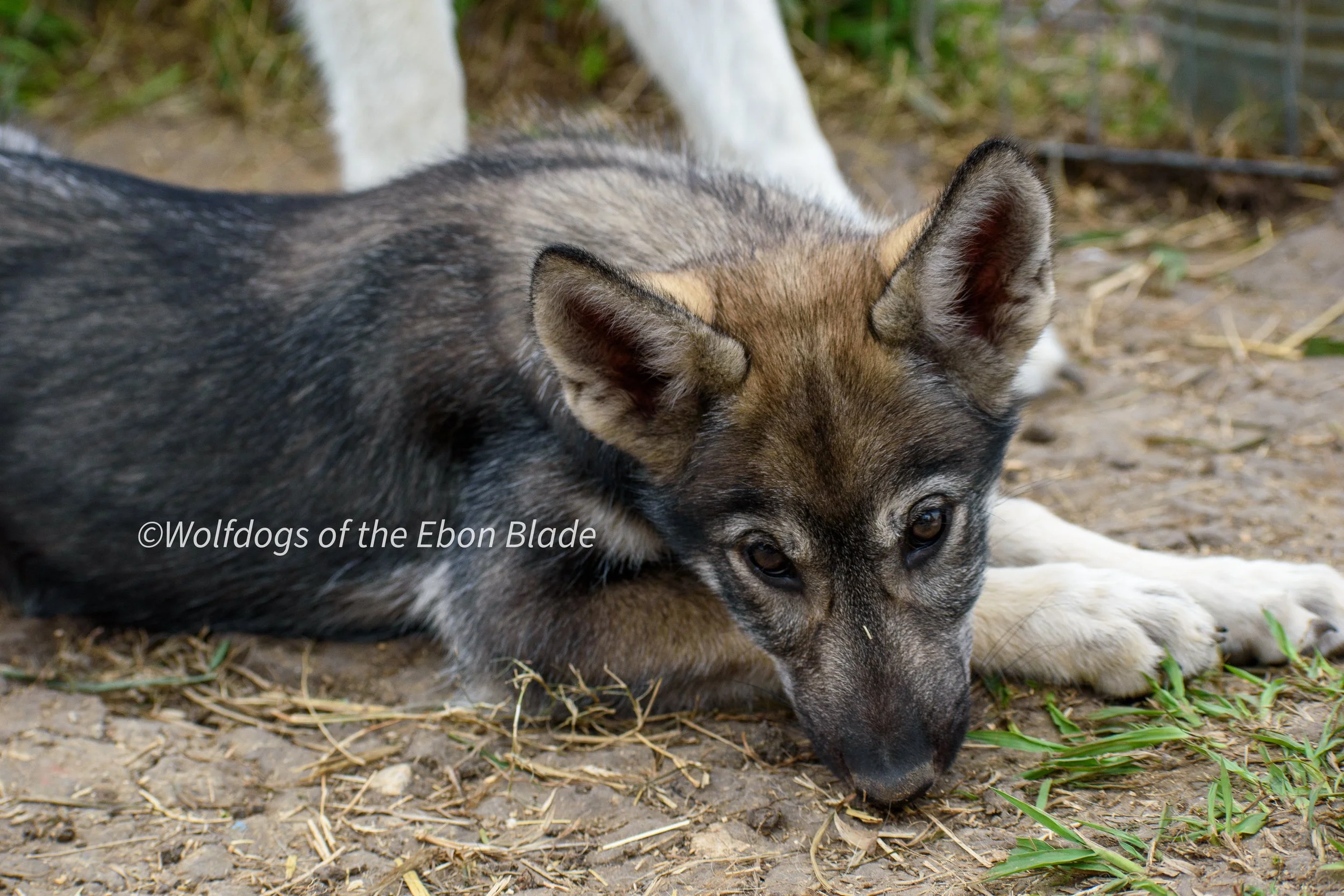
Neither Teddy nor Mint show any resource guarding of high value food or toys towards people or other dogs. While Teddy does have a couple of siblings who resource guard food from other dogs, the majority of them do not. None of Mint’s siblings have shown any resource guarding tendencies, either, so we do not expect their puppies to have any issues with this behavior. We do practice hand feeding raw meals with our litters prior to going home, as well as practice “trading up” with them, where we offer a high value treat in exchange for a toy that they have, so that they can learn that “sharing” is a positive experience. Continuing to practice this is something we recommend to all of our owners for all of our litters, regardless of wolf content, as this is a valuable skill for all dogs and wolfdogs to learn!
We expect a range of friendly to aloof personalities from this litter when it comes to meeting strangers. Teddy is a bit on the shy side initially with some strangers, although he definitely befriends women much more easily and quickly than men. Mint is politely curious when meeting strangers and will sniff them if they offer a hand, but will otherwise not show much interest in being petted by them. Teddy and Mint’s parents are both a mixture of aloof and very friendly, as well, and we’ve seen that range reflected in their respective litters. Part of evaluating our litters for placement includes the Volhard Puppy Aptitude Testing at 7 weeks old, to help determine each puppy’s baseline reaction to meeting and interacting with a stranger in an unfamiliar setting. We’ll be matching each puppy with the home we feel will fit them best, based on what each of our approved homes have communicated during their application and interview process.
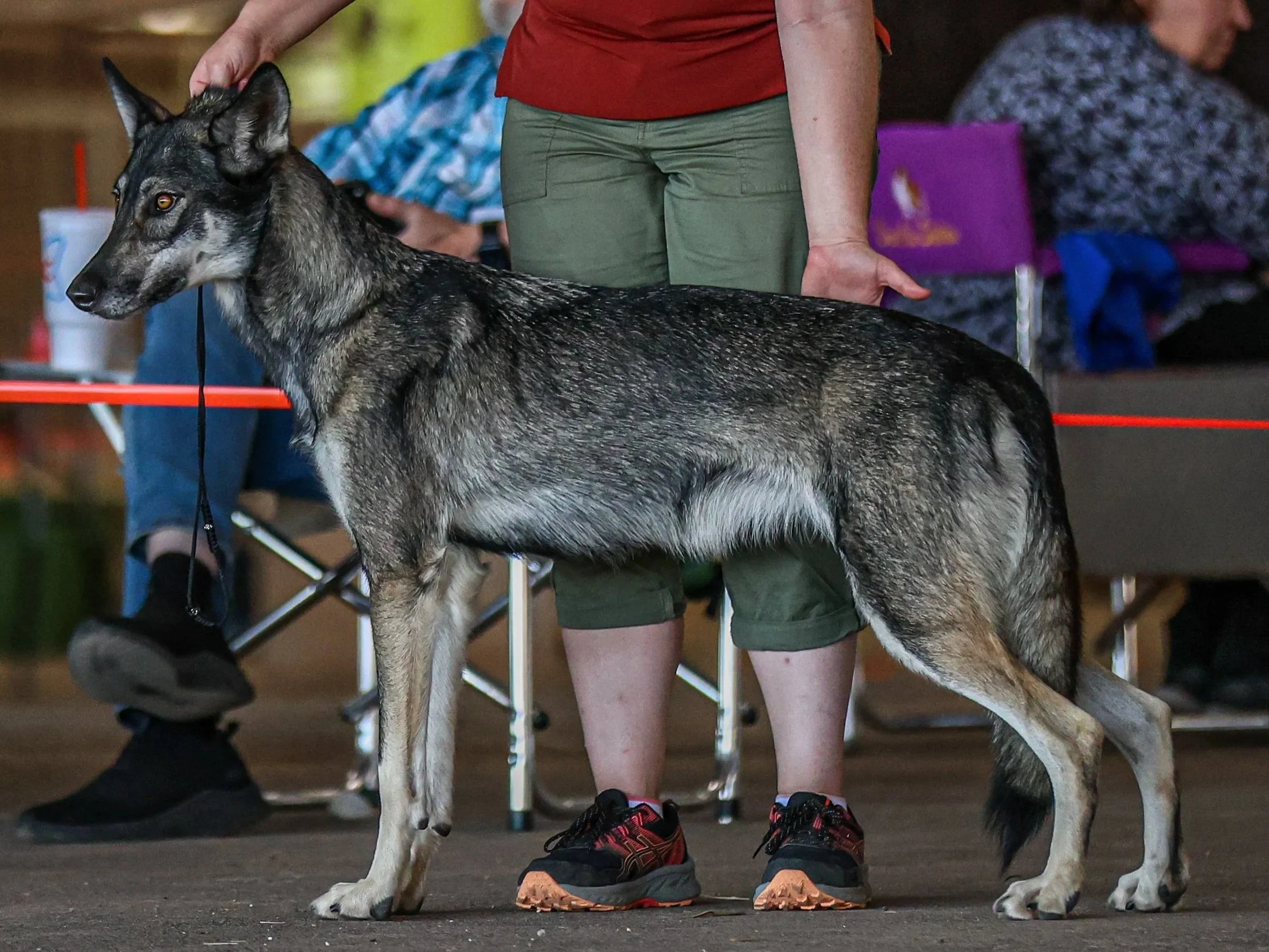
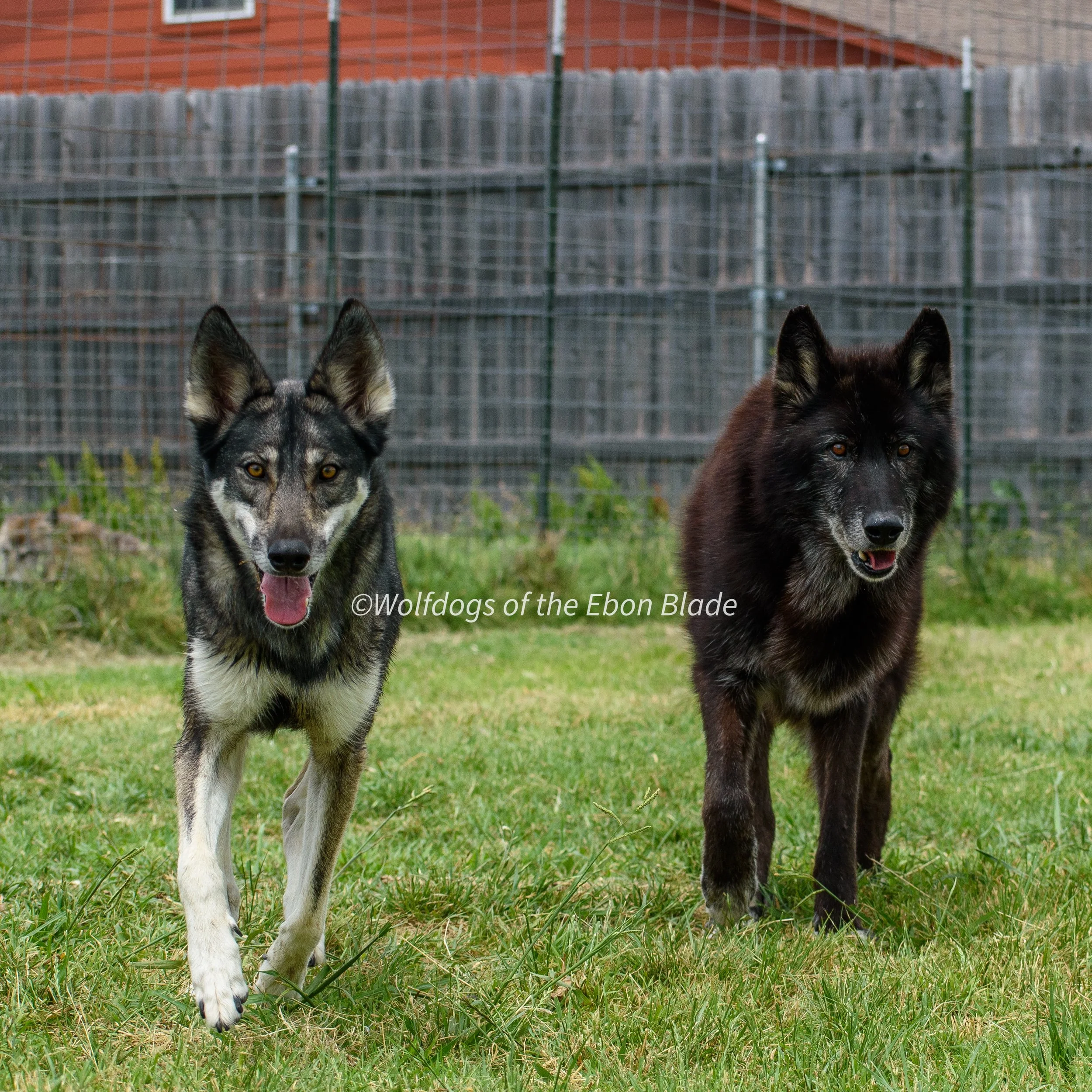
All of the puppies from this litter will have yellow to amber eyes, seasonally thick coats, erect ears, nice front and rear angulation, and heads with nice wolf-like type. We expect this litter to be on the “smaller” side of large breed dogs, averaging between 25-27 inches tall and between 65-80 lbs.
Possible Puppy Colors…
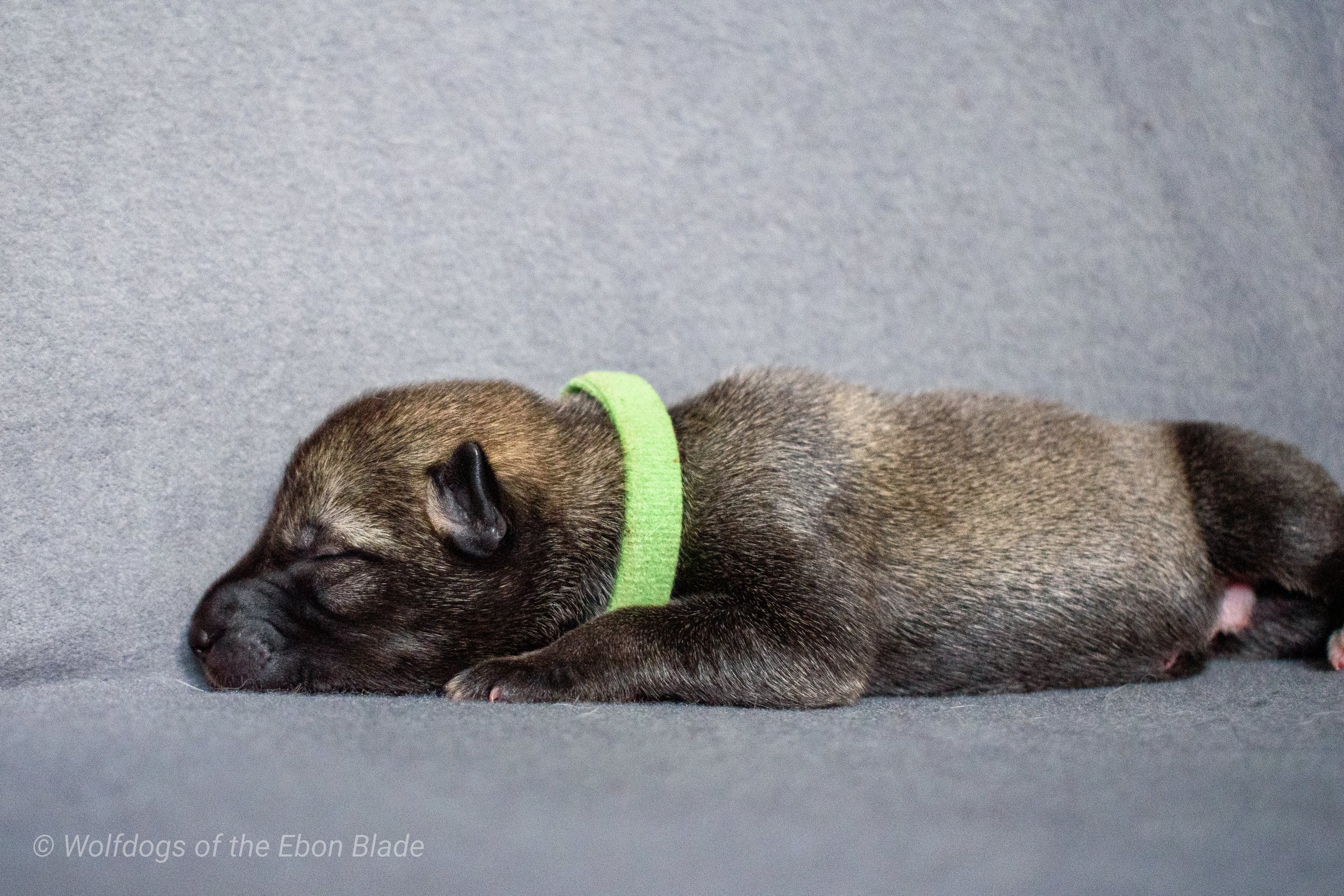
Teddy’s coat color genetics are: E/eA KB/ky aw/a S/S D/D B/B
Mint’s coat color genetics are: Em/E ky/ky aw/at S/sp D/D B/B
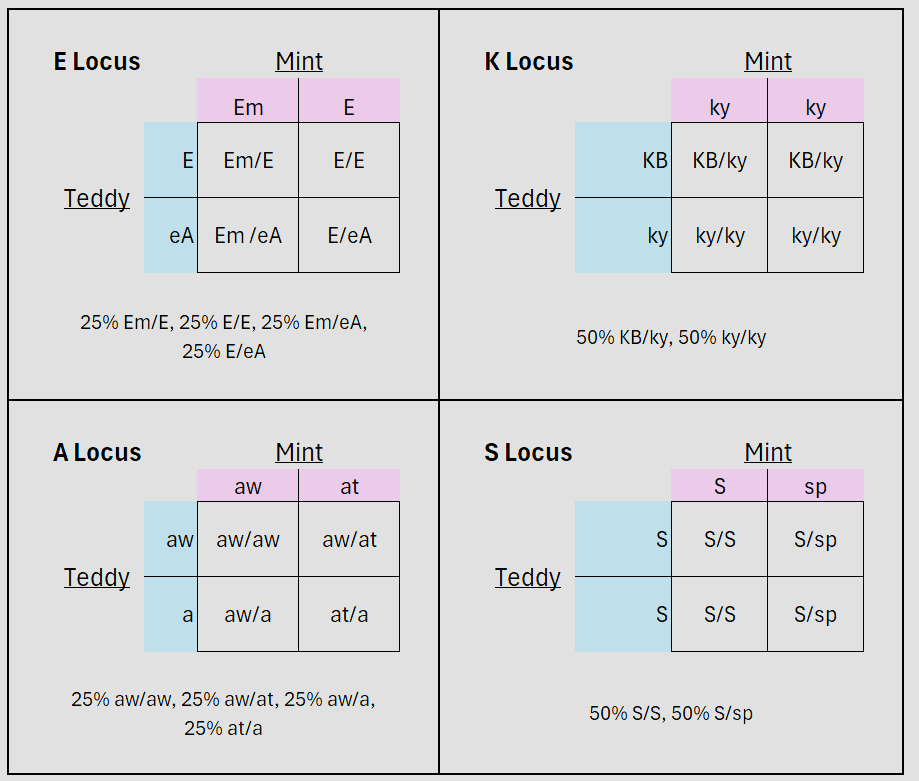
Based on the parents’ coat color genetics, the following puppy coat colors are possible:
25% chance for each puppy to inherit one copy of ‘Em’ Black Masking and one copy of ‘E’ Extension (Em/E). These puppies will have a black mask on their muzzle, which will most likely start to fade away by their 2nd birthday.
25% chance for each puppy to inherit one copy of ‘Em’ Black Masking and one copy of ‘eA’ Northern Domino (Em/eA). These puppies will have a black mask on their muzzle, which will most likely start to fade away by their 2nd birthday. They will not express Domino.
25% chance for each puppy to inherit two copies of ‘E’ Extension (E/E). This allows the coat to have black pigment in it, whose distribution will be controlled by the K Locus and A Locus.
25% chance for each puppy to inherit one copy of ‘E’ Extension and one copy of ‘eA’ Northern Domino (E/eA). This allows the coat to have black pigment in it, whose distribution will be controlled by the K Locus and A Locus; these puppies will not express Domino.
50% chance for each puppy to inherit one copy of ‘KB’ Dominant Black (KB/ky). This is a dominant gene that only requires one copy to affect the coat. Puppies who are KB/ky will have black coats, although it’s highly likely they’ll have a “seal” black pattern, with lighter colored undercoat on their neck, shoulders, and legs.
50% chance for each puppy to inherit two copies of ‘ky’ Non-Black (ky/ky). This allows the coat to have black pigment in it, whose distribution will be controlled by the E Locus and A Locus.
25% chance for each puppy to inherit two copies of ‘aw’ Agouti (aw/aw). This will express as the classic “wolf grey” coat color and pattern.
25% chance for each puppy to inherit one copy of ‘aw’ Agouti and one copy of ‘a’ Recessive Black (aw/a). This will express as the classic “wolf grey” coat color and pattern.
25% chance for each puppy to inherit one copy of ‘aw’ Agouti and one copy of ‘at’ Black & Tan (aw/at). This will express as the classic “wolf grey” coat color and pattern.
25% chance for each puppy to inherit one copy of ‘at’ Black & Tan and one copy of ‘a’ Recessive Black (at/a). This will possibly express as a black and tan coat pattern, although it’s also possible that it may express as essentially identical to agouti “wolf grey.” There seems to be an unknown variant in wolfdogs that tests as ‘at’ but physically shows no difference in physical expression from agouti.
75% chance for each puppy to inherit two copies of ‘S’ for no White Spotting (S/S). Puppies who are S/S are unlikely to have much, if any, white markings on their body. Residual White markings are still possible, as these are extremely common in wolves and wolfdogs. These typically show up as small white tips on toes and a white patch on the chest. This is caused by the pigment in the coat failing to fully spread to all parts of the body when the puppy is developing in-utero.
25% chance for each puppy to inherit one copy of ‘S’ and one copy of ‘sp’ for White Spotting (S/sp). One copy of White Spotting is likely to produce small amounts of white markings on the body, such as white socks, white tipped tail, and/or white chest star.
None of the puppies in this litter will be carriers for Dilute (Blue) or Brown (Liver).
None of the puppies in this litter are expected to phase to white with age, although they may develop some minimal graying on the muzzle as they age.
All of the puppies in this litter will have Sh/Sh stock coats, meaning none of them will be long coated or carriers for long coat.
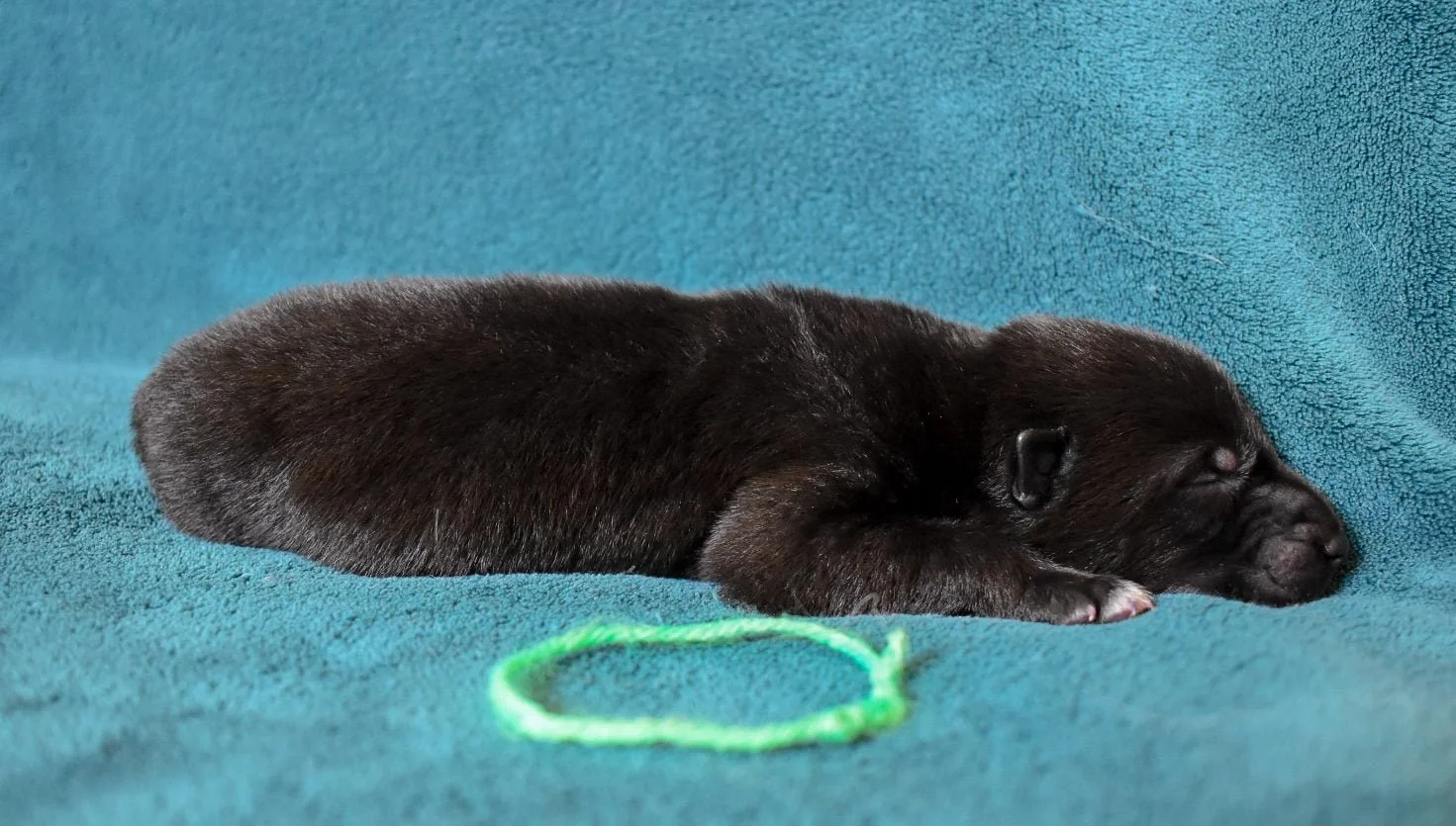
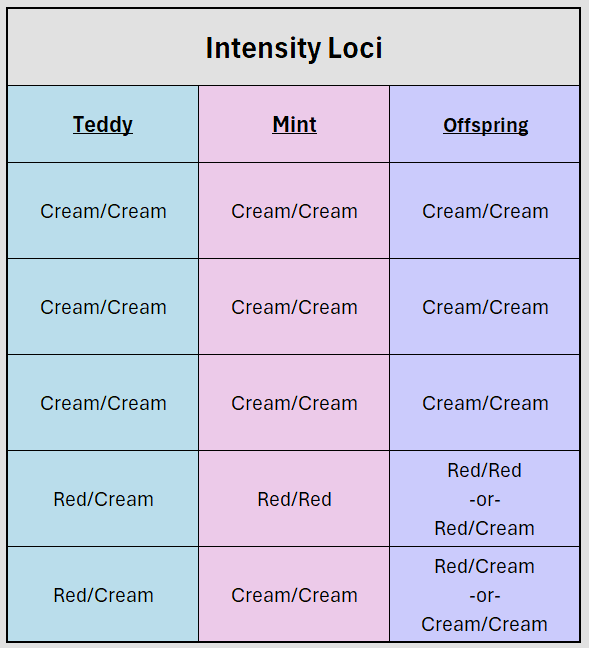
We cannot guarantee the sex, markings, or coat colors available to any puppy buyer for any litter.
If you would like to learn more about dog coat color genetics, click the button below to link to the Dog Coat Colour Genetics website, where they have every known locus and gene explained in easy-to-understand descriptions, accompanied by multiple visual examples.
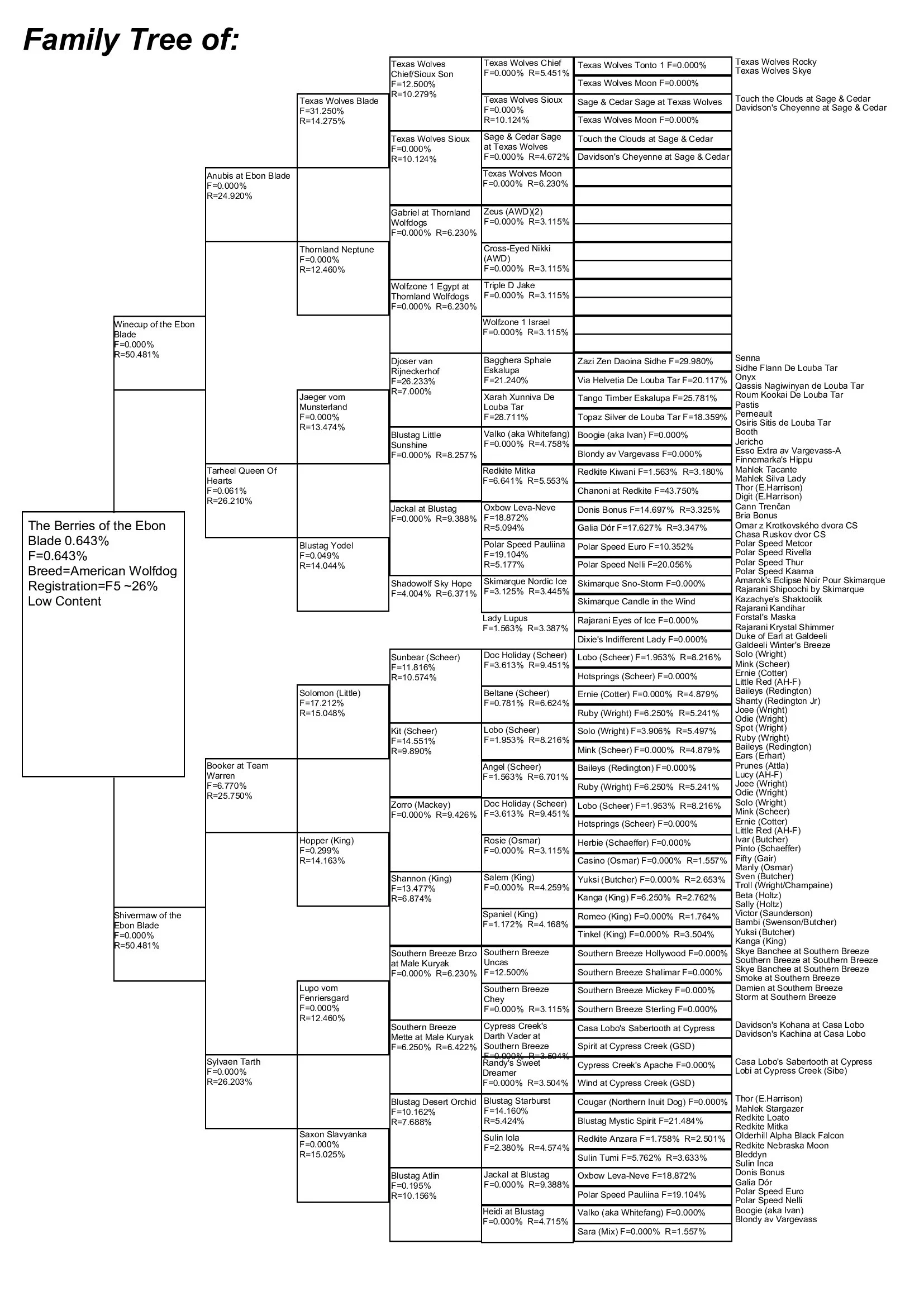
7-Generation Pedigree
Requirements and Additional Info…
This litter is eligible for homes in the USA and Internationally in countries where F5 wolfdogs are legal to own. Please be sure to check your country, state/province, county, city, and any other local laws applicable, to verify whether or not it is legal to own wolfdogs where you live. The legality of wolfdog ownership for every applicant will be verified during the application process.
NO breeding rights will be given for any puppies unless they are being Co-Owned by us, with us as the Breeder retaining the final right of refusal on all breeding choices, to ensure the wolfdog is being bred responsibly. It is our hope that the wolfdogs we Co-Own will mature into healthy and good-tempered animals that will benefit our Co-Owner’s breeding program. We split the cost of all health and temperament testing 50/50 with our Co-Owners. Our intention with Co-Ownership is to provide other responsible breeding kennels access to high quality wolfdogs, for the improvement of the wolfdog breed as a whole. Should the Co-Owned wolfdog fail any of their health or temperament evaluations for any reason, we do require the wolfdog to be spayed/neutered, but we offer a new Co-Owned puppy for free from our Co-Owner’s choice of any of our future litters, not including any travel expenses incurred for them to pick up the puppy. Please contact us directly for more information about our Co-Ownership program. You can also download a sample copy of our Co-Ownership Contract on our Contracts page. Please note that some of the terms for Co-Ownership ARE NEGOTIABLE! The goal is to make things as straightforward and easy for you as possible, while keeping the well-being and responsible breeding of the wolfdog a top priority.
All puppies from this litter, unless Co-Owned as breeding prospects, will be required to be spayed/neutered between the ages of 18 months to 3 years of age, to allow for full maturation before desexing. Ovary-Sparing Spay/Vasectomy is permitted prior to 18 months of age in order to prevent reproduction while keeping the sex hormones intact for property growth regulation. Traditional spay/neuter prior to 18 months of age will void our Joint Health Guarantee, since sex hormones regulate the growth and proper timing for the closure of the skeleton’s growth plates. Pediatric spayed/neutered dogs are at a much higher risk for joint deformities and certain bone cancers. Our Pet Only Purchase Contract includes substantial monetary damages for all live puppies which are whelped or sired by our puppies placed in Pet Only homes, regardless of whether the litter was on-purpose or accidental. Please review our Contracts page to download a sample copy of our contract. We promote responsible containment and ethical breeding practices only, and consider this a very serious matter.
All buyers must have reinforced yard fencing at least 7 feet tall with dig guards on the bottom, or at least 6 feet tall with lean-ins or hot-wire on top and dig guards on the bottom. While we encourage having a secure “lockdown” outdoor pen for all wolfdogs, this is not mandatory for our low content (under 50% wolf content) wolfdog litters. We expect our low contents to be primarily indoor dogs. All fencing must be installed, and any necessary modifications completed no later than August 1, 2026, to ensure everything is ready by the time the puppy is ready to come home at 10 weeks of age. If you need tips on how to build wolfdog-proof fencing or containment, or how to reinforce your existing fencing, please contact us. We are happy to provide advice and photo examples. You can also learn more on our Wolfdog Fencing page, under the Education tab of our website.
Experience with primitive breed dogs and/or wolfdogs is recommended but not required to qualify for this litter. We expect these puppies to be mild in temperament, and they should be suitable for intermediate-level dog owners. If you have experience with “regular” dog breeds, but haven’t necessarily gotten a lot of hands-on experience with very difficult breeds, we expect you should still have the necessary knowledge and skills to manage a puppy from this litter successfully, as we do not anticipate any extreme or overly difficult behaviors in this litter, based on the temperaments of the parents and their family members. If you are in doubt about your skill level or knowledge, please don’t hesitate to contact us and we’ll be happy to have an in-depth discussion with you about your knowledge and experience and how that compares to wolfdog ownership. If we don’t have a litter planned that fits your experience level, we are happy to help recommend you to other responsible wolfdog breeders who we think may have something that fits you better!
All buyers must owner their home OR provide proof that they are in a long-term lease that will last at least 3 years from the time the litter is expected to be born, with a letter written and signed by your landlord giving express permission for their renter to purchase and house a wolfdog AND erect wolfdog-proof fencing on the rental property. NO apartments, condos, or townhomes will be approved, sorry. Stability at home is critically important for wolfdogs to feel safe and comfortable, and it is VERY, VERY difficult to find rental homes that will allow wolfdogs. Most residential insurance companies for homeowners and renters have Banned Breeds lists which include wolfdogs/wolf hybrids. This means that the insurance company WILL NOT cover any incidents that occur if a dog from the Banned Breeds list lives on the property, and the insurance company can even cancel the entire insurance policy effective immediately if they find out a Banned Breed is living on the property. For this reason, most landlords and rental agencies also follow this Banned Breeds list, so they aren’t at risk of losing their insurance coverage on the properties they manage. There are only two USA-based national residential insurance companies that don’t have a Banned Breeds list, which are State Farm and USAA.
![DSC_0631[1].jpg](https://images.squarespace-cdn.com/content/v1/601c9b556690083c71ad0155/13a5f507-1141-4b5f-a1a2-917dafc93b17/DSC_0631%5B1%5D.jpg)


![DSC_0837[1].jpg](https://images.squarespace-cdn.com/content/v1/601c9b556690083c71ad0155/28bd3baf-5318-4109-996f-29283f3d6722/DSC_0837%5B1%5D.jpg)
![DSC_0678[2].jpg](https://images.squarespace-cdn.com/content/v1/601c9b556690083c71ad0155/f566eebe-0d88-4f80-8d50-05c9799994e1/DSC_0678%5B2%5D.jpg)
![DSC_0699_(1)[1].jpg](https://images.squarespace-cdn.com/content/v1/601c9b556690083c71ad0155/8be59cb8-37a6-4062-bdfb-06fd6775c7c4/DSC_0699_%281%29%5B1%5D.jpg)
![DSC_0820[1].jpg](https://images.squarespace-cdn.com/content/v1/601c9b556690083c71ad0155/c209c93b-15cc-46a5-b6b7-a7ac1f0a1879/DSC_0820%5B1%5D.jpg)
![DSC_0907[1].jpg](https://images.squarespace-cdn.com/content/v1/601c9b556690083c71ad0155/786eae4b-c8c6-40d5-ba26-5a49493172f5/DSC_0907%5B1%5D.jpg)
![DSC_0684[1].jpg](https://images.squarespace-cdn.com/content/v1/601c9b556690083c71ad0155/87585a44-8b27-4da4-ab5b-4b92191d5254/DSC_0684%5B1%5D.jpg)
![DSC_0411[1].jpg](https://images.squarespace-cdn.com/content/v1/601c9b556690083c71ad0155/0612b400-b3e5-415a-9319-d9c357cc1b42/DSC_0411%5B1%5D.jpg)
![DSC_0415[1].jpg](https://images.squarespace-cdn.com/content/v1/601c9b556690083c71ad0155/fbe0f86c-0670-46c6-8a0e-bc3cd446921c/DSC_0415%5B1%5D.jpg)
![DSC_0205[1].jpg](https://images.squarespace-cdn.com/content/v1/601c9b556690083c71ad0155/5b444a0e-67d3-40a8-b193-cf25eef372a5/DSC_0205%5B1%5D.jpg)
![DSC_0206[1].jpg](https://images.squarespace-cdn.com/content/v1/601c9b556690083c71ad0155/89158f6c-ec05-40e3-8611-722d875204fa/DSC_0206%5B1%5D.jpg)